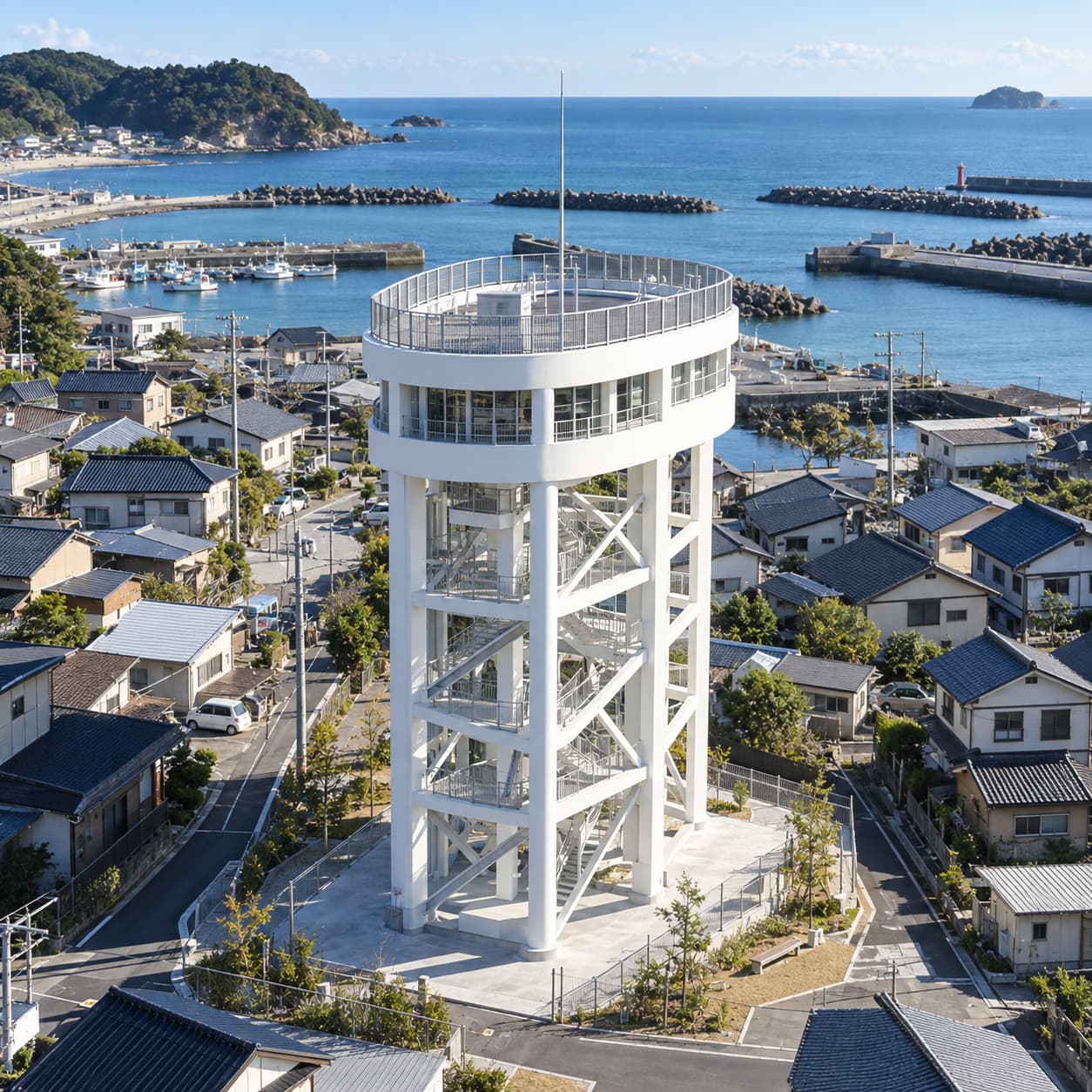
The standard tsunami instruction is to move inland and get to high ground. On much of Japan’s Pacific coast, that advice quietly collapses. The land behind the beach is flat for kilometres, the nearest hill is a twenty minute walk away, and the wave is not going to wait twenty minutes. In the hot spring town of Toi, on the Izu Peninsula, planners expect roughly ten metres of water to arrive about six minutes after a Nankai Trough megathrust. Six minutes is enough time to walk two or three hundred metres. It is not enough time to leave town.
Where the high ground does not exist, the answer is to build it. That is what a tsunami evacuation tower is – an open steel or reinforced concrete structure with stairs, a ramp and a platform above the projected inundation level, dropped into a residential block so that everyone within a few minutes’ walk has somewhere vertical to go.
Why height beats distance
Horizontal evacuation depends on a variable nobody controls, which is how fast the slowest person in the neighbourhood can move. An elderly resident with a walking frame covers perhaps forty metres a minute. A parent carrying a child covers less than they think. Traffic makes it worse rather than better, because a coastal road jammed with cars becomes a trap the moment water reaches it.
Vertical evacuation removes distance from the equation and replaces it with elevation. The target is no longer a hill three kilometres away but a platform two hundred metres away and eight metres up. That shift is what makes the numbers work in flat terrain, and it is why the towers spread so quickly after the Tohoku disaster exposed how many communities had no reachable refuge at all.
What the network looks like now
Before that disaster, Japan had roughly forty five of these structures nationwide. A Cabinet Office survey later counted more than five hundred across Tokyo and twenty two other prefectures, an elevenfold increase. About seventy percent of them stand on the Pacific side west of the Kanto region, and Shizuoka Prefecture alone accounts for well over a hundred.
The money explains much of the pace. Central government covers half the construction cost, and in areas facing serious damage from a Nankai Trough event that share rises to two thirds. Even so, a single tower can leave a small municipality carrying several hundred million yen, which is why coastal towns outside the designated zones keep lobbying for the same subsidy rate.
Towers are only part of the picture. Existing tall buildings can be formally designated as tsunami refuges, and that register has grown from under two thousand structures to more than fifteen thousand across thirty seven prefectures. Designation is far cheaper than construction, but it depends on having suitable buildings in the first place, which fishing villages and low rise suburbs generally do not.
How the structure survives the water
A tower has to stand through two separate events. The earthquake comes first and shakes the foundations for minutes. The wave arrives afterwards and applies lateral pressure plus the impact of everything it is carrying – cars, containers, timber, boats.
The usual response is to let water pass rather than resist it. Open lattice frames at the lower levels reduce the surface the wave can push against, while the load bearing core stays solid. Foundations go deep to resist scour, because the ground around a structure erodes fast when water accelerates past it. Where debris impact is the dominant concern, designers wrap the lower section in windowless reinforced concrete. One notable tower on the Shizuoka coast is shaped as an elliptic cylinder with its narrow end facing the incoming wave, a form borrowed from shark skin, with solid walls protecting the ramp up to fifteen metres.
Platform height follows the local inundation model with freeboard added on top. A municipal tower might put three hundred people at least six metres above ground, which sounds modest until you compare it with the alternative of standing on the road.
The ramp problem
Stairs are the obvious way up and the wrong one for a large share of the people who need the tower. Coastal communities in Japan skew old, and a steep external staircase under earthquake conditions, in the dark, in the rain, with a crowd behind you, is a serious barrier.
Better designs use a continuous ramp winding around the outside of the structure. It costs more, it takes more footprint, and it is the difference between a facility that works for everyone and one that works for the fit. Handrails on both sides, non slip surfaces, solar powered lighting and a stored supply of water and blankets round out a usable platform, since people may be stranded there for many hours before the water drains and rescue arrives.
Concrete that earns its keep
An expensive structure used once a generation is a hard sell. So the better projects give the tower a second life. Platforms double as observation decks, ground levels host community rooms, and one complex on the Izu coast combines a tourist facility with the town’s evacuation function, built after residents rejected a large seawall that would have cut them off from the bay.
That dual use is not decoration. It teaches the route. Someone who has climbed the ramp for a festival, a drill or a view of the sea does not have to think about where to go when the ground starts moving, and thinking is exactly what nobody has time for.